
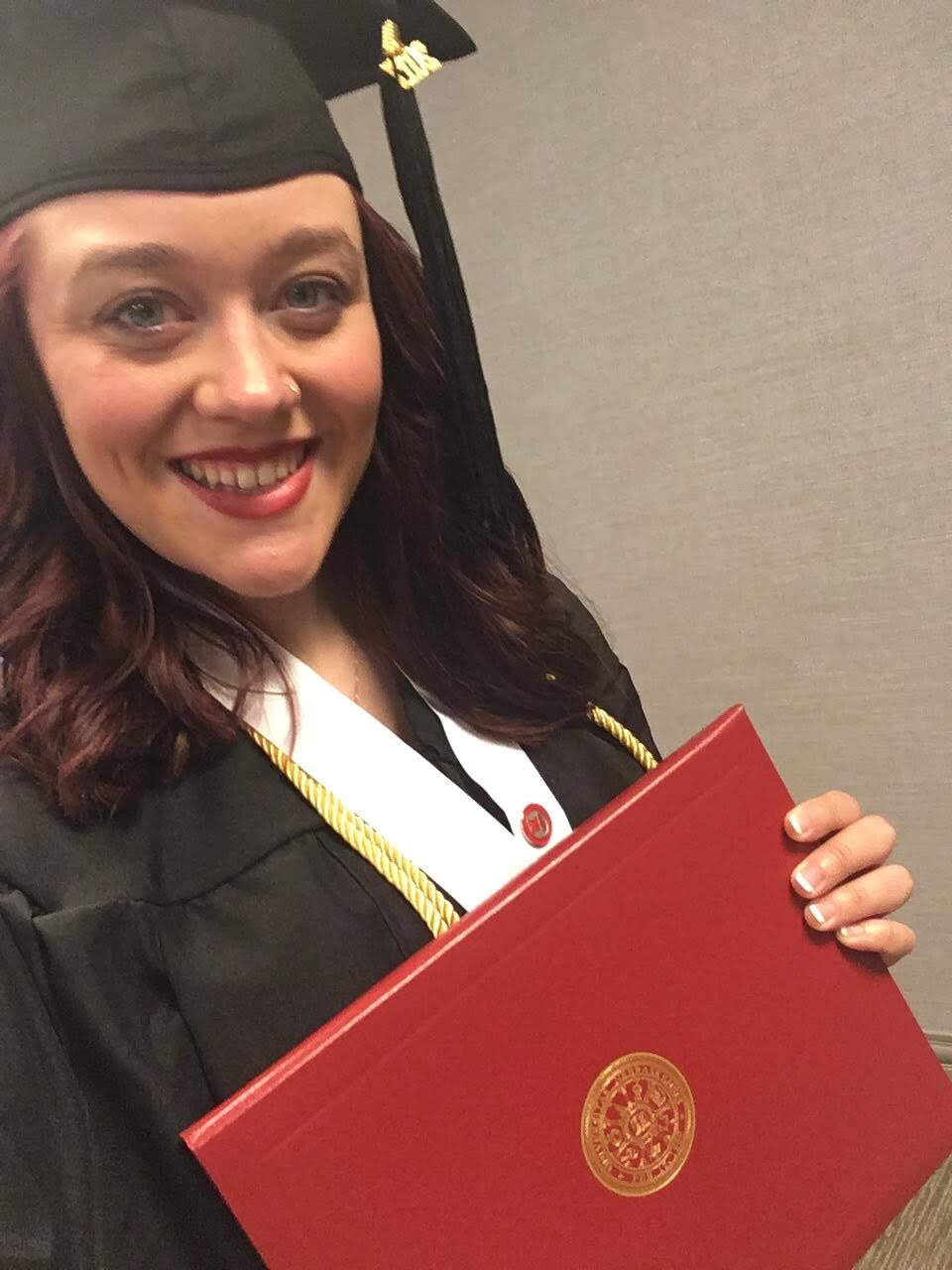
The lie and privilege of “independence”
One of my very first uttered sentences and certainly a favorite was, “I do it!” When I was younger, I liked to fancy myself as a self-made woman. I worked hard all through school, got good grades, and all on my own applied for scholarships and applied for college. On my own, I kept a full-course load, high grades, and jobs all through undergrad. I was independent, and able to do it all on my own.
And that’s all a bunch of bull shit.
The truth is that I had family who read to me as a child, who encouraged me to ask questions, who instilled in me and taught by example the sociocultural skills and behaviors that are expected in the US education system. While my mother’s side of the family is certainly in a lower-economic bracket, my father’s side of the family is in the upper-middle class. My paternal grandparents were financially able to start a college fund for me, they paid for school clothes all through high school, paid for a significant percentage of my car, have covered gas costs coming home, and even were the ones who helped me move out to Monterey.
Where I am today is the result of a great deal of financial privilege. Certainly, I have financially responsible for many things myself and worked hard, but many of the educational and professional opportunities (even the belief that such possibilities were attainable) are because of the financial stability I knew I could fall back on should I need to.
This is all without even explicitly touching on the privilege of being white. Undeniably, much of my financial privilege is intertwined with my race.
People in the Midwest are notoriously polite; we even have a saying: “Nebraska Nice.” If you were to ask people where I’m from, most would probably say that everyone is equal and treated the same no matter race or creed. Even now, I can’t think of witnessing specific instances of systematic or institutional racism in my childhood and adolescent, but I know it was there even if I was completely obtuse and blind to it. I know many people from primary and secondary school who did not have my supportive family life, who did not have family who could pay for new school supplies or club fees.
Certainly, the financial support has been invaluable, but I think a vital element of where I am today is the educational success I have experienced. I didn’t realize until I took a course in undergrad how much of our educational system and culture is based on a white, middle-class way of behaving and communicating. I knew how to play the game of education from the second I arrived. I think this revelation, the way school is practically made for me as a middle class, white student, was a key factor in shaping my desire to fight injustice. As an educator, I truly believe that education and learning is a cornerstone of having a better, more fulfilling life. Believing this, how can I not fight the systems in place in our education system (and larger systems) that make educational success twice as hard and sometimes impossible for people who are not middle-class, white students?


Hi Miranda,
Thank you for sharing and I admire your courage to talk about your privileges to be successful in the US education system. It reminds me of my annotation readings in the Teaching Language Online class. The essays I annotated revealed that students in China and Egypt did not perform well in participating in interactive activities and/or giving comments and feedback to their peers in Global North countries because they are not trained to do so. It seems a lifelong endeavor to find a balance between adapting to and fighting against the system when preparing foreign language students in getting ready for their target education systems while fighting the hegemonic discourse or systematic unfairness within the systems.
Thank you Miranda for sharing your personal experience and background. I think it is important for strong women to share their own background, stories and history of how they got where they are today in order to empower and build other women who are continuing to build and grow their personal self. Although you had guidance and support to help you in your previous years, you are where you are today because you “did it”. It may seem like we have little control in our life, but we carry much more power than we believe or we tend to forget. As a student and child, we only carried so much power and we did not choose our upbringing or existence. However, now as educators we are able to help change and empower educational systems within communities to help students who don’t necessarily have a voice or power. There is much variation between power and control, and as you mentioned in previous classes, this isn’t necessarily a bad thing it just is about how we go about using the power.
Miranda, thanks for this candid reflection and openness. I honestly don’t know much about Midwest. Studied in the East coast, working in the west coast, and traveled quite a bit in the south but Midwest is a mystery to me. Would you characterize yourself as a Midwesterner? I don’t know the racial and ethnic distribution in Nebraska either, so when you said “even now, I can’t think of witnessing specific instances of systematic or institutional racism in my childhood and adolescent, but I know it was there even if I was completely obtuse and blind to it.” Did you grow up in a white community? went to diverse schools (or not)? Because often times we feel like we don’t witness racism in our environment, when it is actually right under our nose. Kinda like the absence of LGBTQ+ discrimination in textbooks doesn’t mean that heteronormativity doesn’t exist. It does because they are absent! So yeah, I wonder what you think about it.
Hi Deniz, thank you for your thoughtful comments and questions. Part of me will always call myself a Midwesterner because it’s where I grew up, but I know that politically and ideologically I don’t really align with a majority of Midwesterners, so in that way I feel disconnected from that identity. Nebraska is a very white state, 87% in fact. In my hometown of Scottsbluff, the population is 90% white according the the 2020 census. My perception was that we had/have a “large” (for Nebraska) Mexican/Hispanic community, but I’m not sure what percentage.
As I’ve gotten older and more aware, the systemic racism I see in my hometown is that a certain neighborhood called “East O” (because of the street name) has a reputation for being “dangerous.” Many of the houses appear more run-down as well as the businesses that line the streets. Housing is cheaper in this area, and the perception is that the community is largely Mexican/Hispanic (although I have no idea what the actual demographics of that area is). The intertwining of issues on race and class is very evident in this neighborhood. So I know discrimination was happening in my high school, but I was so oblivious to it, I don’t have any specific examples that I can recall.
Thank you so much as you have been willing to share information with us.
syair hk
Bandar Togel Terpercaya, Slot Teraman Rekomendasi Para Bintang Player Taruhan Online Dengan Hadiah Melimpah Anti Rungkat
rusa4d
kijangtoto
rusa4d
kijang toto
kijangtoto