
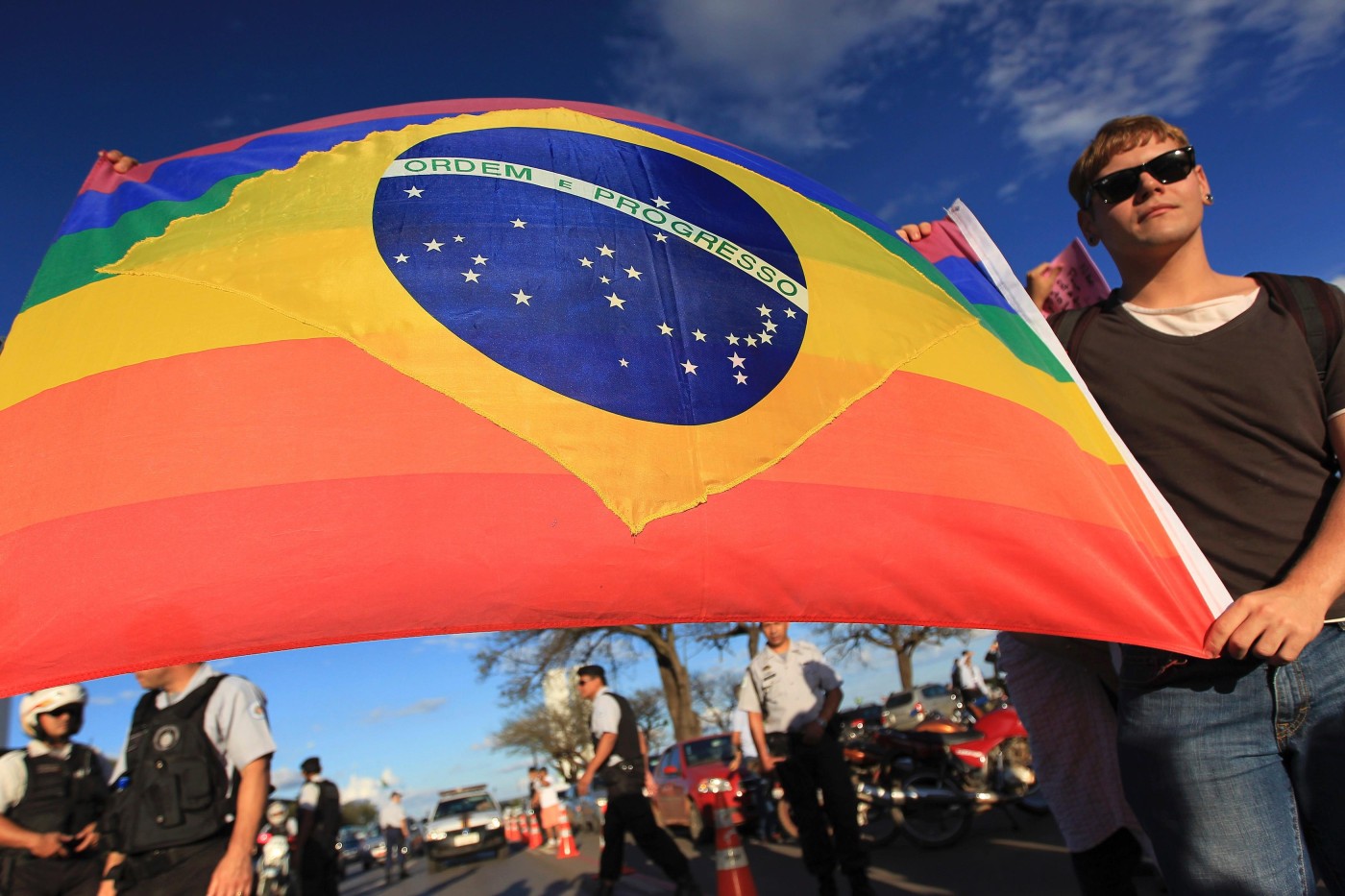
Reflection: Desordem e Regresso – LGBTQ Rights in Brazil
The following reflection is based on my past experience in Brazil. Although I am uncertain as to my specific future context, I hope that my future career brings me back to Brazil or Latin America. Identifying as LGBTQ in Brazil is a very tricky subject and totally dependent on who you are talking to. The general population will default to the progress narrative of “Gay marriage is legal, and Brazil is one of the first South American countries to do this!” In reality, Brazil is heavily dominated by the evangelical/protestant/catholic narrative of marriage only being socially acceptable between a man and a woman and being gay means being abnormal. Even though I lived in a small college town where the LGBTQ community was expansive, I witnessed first hand the smaller discourse communities that ostracized LGBTQ people. This town was nested in a larger rural state [Minas Gerais] that is very much behind the times when it comes to issues of LGBTQ acceptance, sexism, and racism. I remember hanging out with a guy who said that trans people were “unnatural,” and briefly dating a guy who would not hang out with my gay friends because he “didn’t feel comfortable.” I remember comforting my best friend after someone had poured an entire beer on him simply because he was gay. I remember this same friend hiding his sexuality from his employer so that he would feel trusted by administration to be around children. I remember him telling me how his mother, who is deeply catholic, sent him and his brother to a psychiatrist and asked the doctor to “fix her son,” to “rid him of his disease.” I remember straight people using the term “viado” [faggot] as a joke to refer to their friends. And I will never forget being in Brazil when Marielle Franco, a black, bisexual city councilor in Rio, was brutally assassinated in the streets – to which absolutely no police force responded. Needless to say, coming out in Brazil is not something that people usually announce. As Nelson (2010) and Santiago (2002) discussed in their studies concerning LGBTQ students, expression of sexual orientation and coming out in Latin America is more craftily nuanced rather than verbalized as it is in the United States. If you belong to an LGBTQ discourse community, you know the sexual orientation of the members of your community – and generally it is taboo to speak about it outside of that community.
I was always shocked at how my best friend would intentionally not express his sexual orientation in his teaching jobs. Discussions about issues of LGBTQ identities and rights (or lack thereof) were absolutely prohibited in the classroom. I remember this prohibition not as a written policy, but rather as a word of mouth policy/organizational culture for all of the schools that I worked in in Brazil – especially k-12 (I taught 3rd grade). LGBTQ was simply neither “normal” nor something that was talked about in school or in the community unless you identified as a member of this community. One thing I found enormously frustrating is that this issue was much more problematic for gay men or trans women. In the overly emasculated/machismo culture of Brazil, it was simply a turn-on or a +100 points on the sexiness scale if a woman identified as bisexual (such as myself) or a lesbian. The same man I [again, briefly] dated who told me that he thought my gay friends were weird, literally got a hard on when I told him that I have also dated women. Being a bisexual, white, blonde, English speaking foreigner, I was in a position of privilege and power that absolutely contradicted the societal stigma against GTQ identities. This issue demonstrated the lack of understanding that people had of Bisexuality and Lesbians as well – which I find does happen in the United States but is not quite as extreme – people don’t understand that being bisexual means not just sexually attracted to other women. Another contradiction to the general dismay over LGBTQ identities is that the same men who looked down upon gay men or thought being “trans” was unnatural would cross dress as women for Carnaval as a joke. But, I digress.
Living in Brazil strengthened my belief that worldwide LGBTQ rights are still heavily under attack, and the fight has just begun. The title of this reflection is “desordem e regresso” –> [disorder and regress] .- a play on words of Brazil’s motto which is written on their flag -> “ordem e progresso” [order and progress]. This play on words is constantly used in social justice activism and protests, especially in the LGBTQ fight. My best friend is now a sexual migrant who has obtained legal status in the US as a political refugee because he felt his entire life was threatened back at home. When I was developing a risk assessment for US students to study abroad in Brazil (a simulation for another class), I came across some very shocking facts and statistics. The United States Department of State (2019) currently suggests in their travel advisories for Brazil that LGBTQ travelers exercise caution, as “according to the 2017 Human Rights Report, violence against lesbian, gay, bisexual, transgender, and intersex (LGBTI) individuals was a serious concern, with local NGOs reporting that in the first half of 2017, 117 LGBTI persons were victims of hate killings” (p.17) . Identifying as part of the LGBTQ community in Brazil is not only social taboo, it is dangerous.
It is absolutely essential that teachers be allies to their LGBTQ students in Brazil, as they should be allies to any of the LGBTQ allies in any context. To me, being an ally meant being a supportive friend, being a shoulder to cry on, and being a place to go. I wish that I did not let my fear of job repercussions discourage me from engaging in conversations concerning the LGBTQ community in Brazil, especially in the University classes that I taught – where I only briefly talked about these injustices. Being an ally could take many forms as a teacher in Brazil, but the first and most essential step is creating a classroom where students feel their identities are welcomed and celebrated as opposed to treated as abnormal or “an insult to god.” Teachers can and should stand up for their students and for their fellow colleagues against administration and use the laws in place to back their activism. Given that the current president of Brazil, Bolsonaro, has said things like “I would rather have a dead son than a gay son,” – now, more than ever, we need LGBTQ allies and teachers in order to return to “ordem e progresso”.
References
Nelson, C. D. (2010). A gay immigrant student’s perspective: Unspeakable acts in the language class. TESOL Quarterly, 44(3), 441–464.
Santiago, S. (2002). The wily homosexual (first–and necessarily hasty–notes). In A. Cruz-Malav & M. F. Manalansan IV (Eds.), Queer globalizations: Citizenship and the afterlife of colonialism (pp. 13-19). New York, NY: New York University Press.
United States Department of State. (2019). Brazil international travel information. Retrieved from https://travel.state.gov/content/travel/en/international-travel/International-Travel-Country-Information Pages/Brazil.html


Hey Kate! Thanks so much for sharing about your experience and research on LGBTQ communities in Brasil. I think Colombia has a very similar culture and perception about gayness. I taught at a Catholic school in Colombia, which made being gay especially challenging. My students would constantly call each other “gay” and laugh and actually many teachers did the same. I had a few students who identified as gay and lesbian. One of my lesbian students suffered from extreme depression and was constantly in and out of the hospital. I guess her parents wanted to beat the gay out of her 🙁
Anyways, because i know you want to be a teacher-educator I am wondering if you would teach teachers any differently in the US vs if you were in Latin America? Thanks for sharing 🙂
Here’s more about Marielle Franco for those who would like to learn more about this horrible event:
https://www.theguardian.com/world/2018/mar/18/marielle-franco-brazil-favelas-mourn-death-champion
https://www.nytimes.com/2019/03/14/world/americas/marielle-year-death.html
Hi Kate,
Your comments about bisexuals reminded me of this movie titled Colette (about a French author) that I saw a few days ago. She is the author of the famous Claudine stories which were published under her husband’s name. Her story of course is very interesting – and her relationship with her husband who is notoriously infidel. At one point in their relationship they have an affair – separately not together – with the same American woman. What was interesting in this scene was that the husband knew about their relationship and was OK with it all along, but hid his own affair with the same woman. He was also OK that his wife has affairs with other women but it was a “no no” when it came to other men. And I can see this happening in other contexts as well. What is that lesbian relationships are not considered a thread to patriarchy or masculinity or not found infidel? At least in this context…
Hi Kalina and Deniz!
Kalina – I don’t know that I would teach much differently – however, this is easier said than done. If I were to return to Latin America, I would choose to work for an organization where diversity is embraced and identities are respected – but this is tough to find in Catholic/Christian driven countries like Brazil (at least companies/schools with diversity and inclusion in their mission statements). But I do always think – teachers with social justice on our radar are perhaps needed most in schools that historically aren’t inclusive- right? But then again – are we putting our salaries in danger by challenging administration? I’m always wondering that – do I choose to work in an organization that already accepts and welcomes diversity such s LGBTQ identities, or do I choose an organization that maybe does not and try and make change there? I don’t know.
Deniz – This contradiction always infuriates me and I have experienced a very similar story.
thank you for all the information that has been conveyed here, hopefully it can be useful.
Thanks for sharing.
Paito warna hk lengkap sebagai racikan angka main data hk terbaru malam ini
Paito HK
Paito Warna HK
Paito Hongkong
Paito Warna Hongkong
Data Warna HK
kawanmenang Most Popular With The Best Choice Kawanmenang
This deserves more attention.
Looking forward to your next post!
Every sentence here adds value.