
Not your baby! App for Sexual Harassment
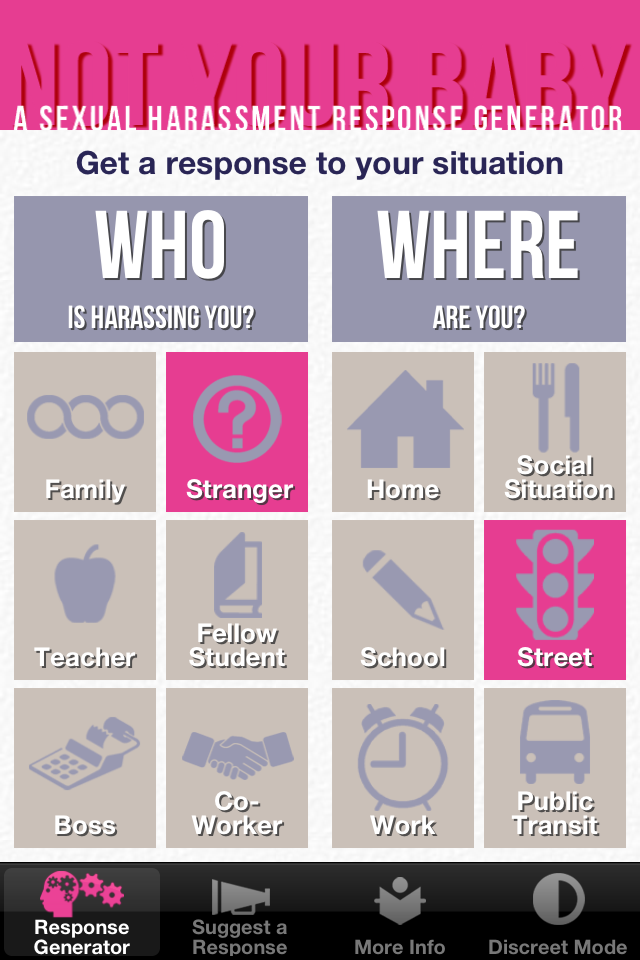
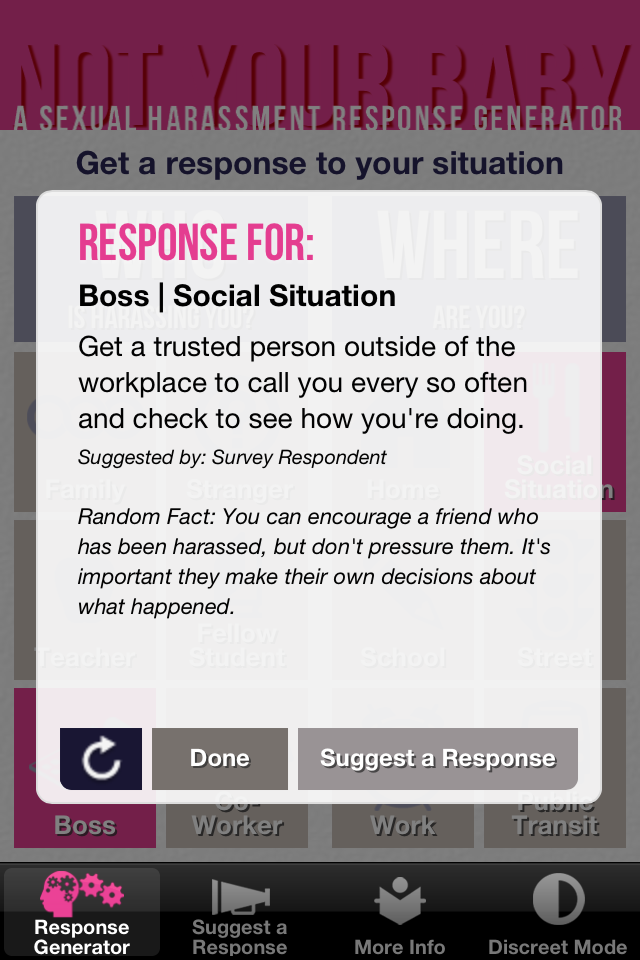
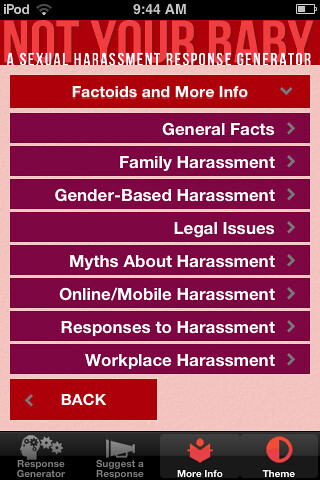
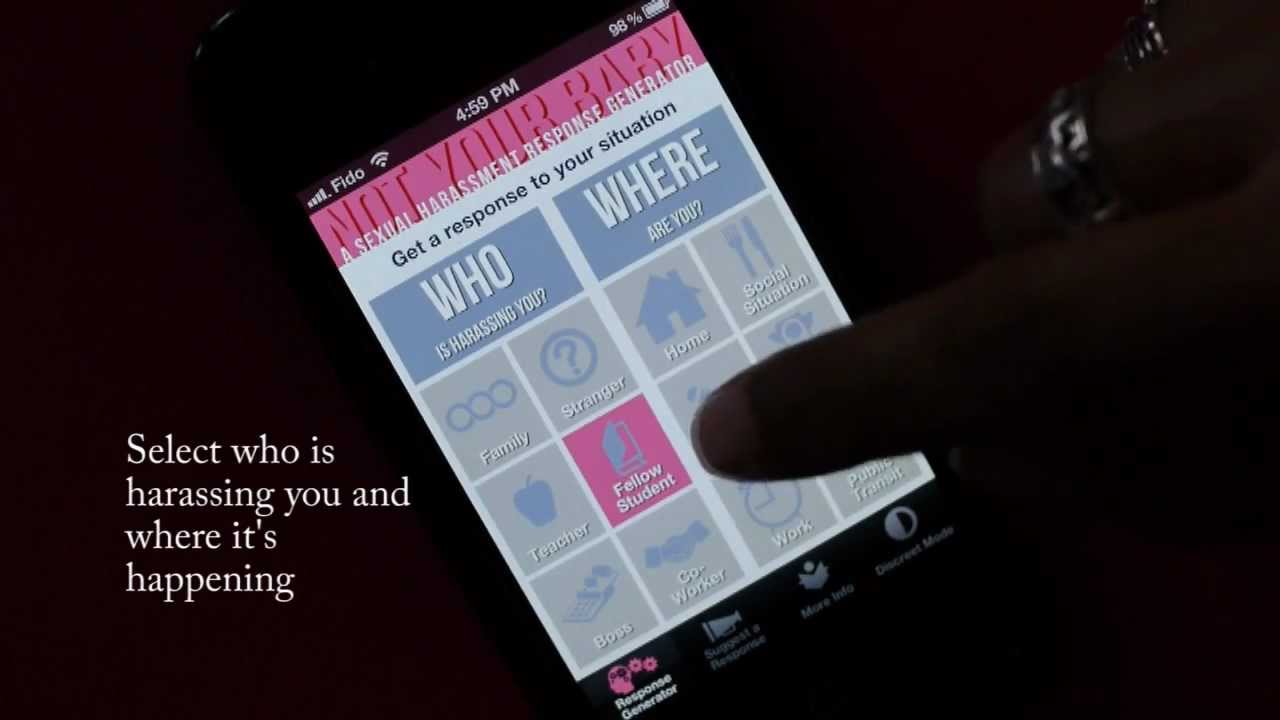
The Not Your Baby app allows the user to report and record sexual harassment and provides the individual with suggestions for responses to the situation. I like the app because it doesn’t seem directed at women – men [and other gender identities] can use it too. Users are free to add suggestions for response. The response pictured above doesn’t really put the victim in an active role. It almost has them just kind of accepting the harassment and seeking support.
I wonder how this app is getting used. I wonder how they control which responses get approved and which do not.
This app seems like a bandaid resolution for harassment and rape culture – but it is a resolution. However, we the fact that we have an app like this is messed up. We are at the point where we need a strategized network to tell us how we can respond.
Does this app normalize harassment? How else might you critique the app? What could be added/taken away from the app?
I think asking your students these questions ^^ above would make an interesting class – but it is a sensitive topic. What do you think? I invite you to answer these questions yourselves.


Wow- never thought there would be an app like this. I wonder if the results are transmitted to the police?
One of my Turkish students this summer was harassed walking up the stairs from the subway in Ankara when a total stranger grabbed another man who was video-recording these two women walking up (recording underneath their skirt I guess). So the other man noticed this and caught the man and told the girls. When I first heard this – and my student said they thought the same – I thought the two men were in it together and it was a con to get them somewhere quiet. It wasn’t. Anyways, so they ended up at the police station, the police appreciated reporting the incident but said these things happen all the time (recordings). My student was in NYC last year as part of Fulbright and was familiar with the harassment campaigns there. So after the incident, the head of the police in Ankara called her to set up a meeting to see what kind of campaigns they can run in Ankara to stop these incidents from happening. Such an app could be useful but then would it lead to more policing in our lives or what happens when there are false accusations? If the photos are publicly available – like Instagram – that might lead to public lynching in some countries like Turkey. I don’t know- I am very suspicious of this app (who designed it? what’s the actual purpose? who benefits from it?)…
Others?
Oh I found the name of the app a bit bizarre too (lacks seriousness, no?)
Ugh- the situation of your student is cringe-worthy. I would guess that these are not reported to the police – and I wonder what difference it would make if they were. The police would need a name to identify the person, and I don’t think women who get harassed ask the person for an ID card (although I wonder, should they?). Then there is the question of what is considered harassment by the police and what is not. I don’t think the police consider catcalling a crime but I could be wrong. It may be in a law against sexual harassment, but I personally don’t see this type of harassment being policed. Could it be? I wonder if you were to approach your harasser, engage them, and then get their name. Isn’t that entrapment if it ends up in police involvement? These are difficult questions, but important to ask. It reminds me of Jeanne’s post about the use of the word “illegal alien” becoming illegal in NYC and how these rules are actually being implemented if there are no witnesses.
In regard to Kate’s statement about how it’s weird that this app places all of the responsibility on the receiver of the harassment and not the harasser, it reminds me of a startup company called Undercover Colors (https://www.undercovercolors.com/) that has developed a discreet tool to test whether your drink has been drugged. Like the app, it places the responsibility on the (intended) victim, without assigning any responsibility to the attacker.
Ditto to the above questions and comments. To play devil’s advocate, could this app be useful to a person who has been sexually abused and does not know what to do, but wants to do something? I agree that the app does not go far enough as to report the abuse to the police and that it places the responsibility on the victim. Could this prevent someone who has been sexually abused from filing a police report for a serious asault because the app said just “talk to a friend?”
Wow, I have mixed feelings about this app. I think it’s difficult for victims to come forward, and in some ways this app offers an alternative approach to seek help anonymously. Yet, like others, I question the advice given and also consider the timing of when it would be used. It’s not like someone would stop and check this app in the moment of an assault, it would be more like an afterthought. I think if it has links to hotlines that could offer assistance that would be more actively beneficial.
Regarding “Undercover Colors,” that Jacob mentioned, I admit I have been in situations where I might have used that product, if I had it. Yet I’m also appalled by the fact that we live in a society where a product like this exists and is being marketed for profit! The directions on the website say, “One line means your drink is spiked. Discard it.” where, I think it should say, “One line means your drink is spiked. REPORT it!” But, that’s just my opinion.
I think using these sources would promote beneficial dialogue in a class (under the right circumstances) and allow students to explore an area of culture that is hidden and not generally spoken about.