
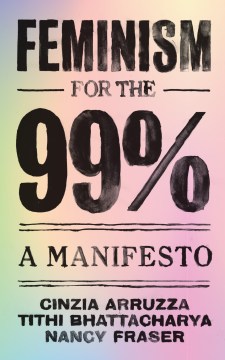
Reflection #2: “Feminism for the 99%” (2019) by Arruzza, Bhattacharya, & Fraser
Reflection #2: Feminism for the 99%
- Brief summary of the book
For this assignment, I listened to the audio version of Arruzza, Bhattacharya, and Fraser’s Feminism for the 99%: A Manifesto (2019). This jargon-laden longform essay is divided into eleven theses regarding social class interpreted through a feminist lens followed by a postface that expands on ideas introduced in the theses.
As a person who proudly identifies as a queer feminist, who has a college education, who is fairly well-versed in discourses around social justice, who likes to use SAT vocabulary in both my speech and writing, who grew up poor, and who is still working class–i.e., a person who should be invested in and energized by the topics raised in this work–I found the language used in the book alienating, unengaging, and, honestly, boring (I stopped listening multiple times, and had to force myself to come back to it six or seven separate times). Sentences such as: “Contra fashionable ideologies of ‘multipilicity,’ the various oppressions we suffer do not form an inchoate, contingent plurality” and “Increasingly financialized, globalized, and de-familialized, capital is no longer implacably opposed to queer and non-cis sex/gender formations” made for neither easily digestable reading nor for profound, inspiring “a-ha” moments, which would spur me to action. In short, for me, this reading lacked joy in every sense of the word and was a struggle to get through. I would even go so far as to describe the text as classist and elitist itself given the authors’s use of such unnecessarily dense language, which is categorically not accessible to the 99% it purports to speak for. I would summarize the important themes of the book as:
- Women and other people with uteruses (e.g., some transmen or gender nonconforming folks) create the workers of tomorrow. Their labor in childcare and rearing goes unpaid, unappreciated, and is exploited by capitalism. [FACT and 100% true.]
- Intersectionality is important, but it all fundamentally comes back to class and capitalism. [I disagree with this stance, but I understand it as a stance.]
- Feminism and queerness have been coopted by neoliberal capitalism. [I agree, but the authors provide no road map or ideas as to how to decouple these from their cooptation.]
- The pedagogical use of the book: If you can consider using it for language teaching purposes, and if so how. If you think you can’t, then articulate your reasons for why.
I absolutely would not use this text in an ESL class unless the students were advanced in their English language skills and were taking political science, philosophy, economics, or gender studies classes at the tertiary level. With students in any other field or at any other proficiency level, this text would be completely inaccessible.
- Discussion points in the book for your students to reflect on
If I were ever going to assign this book, I would have my students read it in concert with the Combahee River Collective Statement (1977), and gauge their responses to each and do a compare-and-contrast in style and ideas conveyed. The dedication page in Feminism for the 99% states they wrote this book “[f]or the Combahee River Collective [CRC], who envisioned the path early on and for the Polish and Argentine feminist strikers who are breaking new ground today.” The writing styles of the two groups of authors could not be more diametrically opposed, and I would be curious to see which work made more of a positive impact on the students and they felt they could relate to more. For me, Feminism for the 99% is written in the language of the White, Euroameri-centric, masculinist academic tradition, and of little utility to those it professes to lift up or benefit.
- How the book embodies/reflect the core concepts and issues we discussed in the class
This book is a classic example of Marxist literature that is about poor people, but not actually for poor people (after all, Marx and Engels were members of the bourgeoisie themselves). What I mean by this is that a person working in the service industry (e.g., a cashier at Subway or maid [sic] in a hotel), out in the fields harvesting crops, or teaching the next generation in our public schools are extremely unlikely to pick up this book, and if they ever did pick it up would be unlikely to finish it.
The book includes core concepts of social justice, social critique, and addresses the importance of intersecting identities, but I think there are far more accessible texts that I would prefer to assign and have students engage with–e.g., bell hooks’s “Where We Stand: Class Matters”. As hooks says in Teaching to Transgress (1994), “any theory that cannot be shared in everyday conversation cannot be used in educating the public” (p. 65). I wholeheartedly agree!


Hi Greg, thank you for your incisive and thoughtful reflection!! I can’t believe this book actually has “for the 99%” in the title. Do you think the authors really didn’t detect the irony of this? I’m kind of embarrassed for them.
I also wonder, how can the authors argue that everything goes back to class and capitalism? Are they arguing that all forms of oppression are somehow for economic reasons?
I love your suggestion to use this text in tandem with the Combahee River Collective statement. I am sure the hypothetical students would find that text much more accessible. I totally agree with you and bell hooks that inaccessible text cannot be used to educate the public. Feminism of the 99% by definition must be inclusive and accessible to everyone. Sadly, the CRC’s statement that the feminist movement is not inclusive rings true still today. I feel like someone should write to the authors and ask them to write a version of this book that is readable by the actual 99%.
Also, thank you for calling out Marxist writing for what it is. Even if Marx and his followers have some ideas that could resonate with working-class people, these ideas seem to be for academics and elites to discuss at dinner parties or conferences, closed to the very people they are talking about. This is why I think you cannot purport to care about the working class or otherwise oppressed unless you actually engage WITH them in your work.
Hi Greg, thank you so much for your clear and honest interpretation of this reading! I am so glad you called out this text for hypocrisy on the way it uses language. It is texts like these that remind me of my privileges as an L1 English speaker. I can only imagine what it is like for folks who speak English as a second/third+ language to encounter papers like this in college. Like you said, it probably leads them to feel further alienated from the “knowledge circle” in the classroom and is also an attack on their self-esteem. Also, this was a good reminder for me personally to check my writing/speaking style in the language classroom. I know I have a tendency to write somewhat formally in academic settings, and I do not want my personal style to alienate my learners. What you said at the end (“it’s about poor people, not for poor people”) is going to stick with me for a long time and inform my future teaching practices. Thank you!
Hi Greg,
Thanks for the great reflection. I’ve never read this book, but I’ve seen it around and I was interested to hear your thoughts on it. I like the way you were able to incorporate it into a classroom setting, even though you found it unengaging, alienating, and boring. The idea of the students comparing and contrasting this book with another could create a large discussion about what feminism is, how it is acted out in society, and why there are so many different opinions on it. I think that would a very interesting class, but I agree with your assessment that it should be for students with a higher language level and taking classes on the subjects listed.
I also love the quote from hooks at the end there. I agree with it completely too!
Ah, it’s a shame that the book turned out to be elitist and classist in its language. I think I have the book at home in Monterey but I don’t remember actually reading it. This might be why. Like Sarah, I love the bell hooks quote. Well said!
Embarking on a captivating journey through the insightful realms of this blog has been truly enriching! The exploration of diverse topics and perspectives has broadened my horizons. Ready to dive into the treasure trove of knowledge? explore now for an enlightening experience