
Reflection 2- LGBTQ+ in high school Mandarin Classes in Private High Schools
I interviewed two Mandarin teachers in private high schools in the United States, one in California, the other in North Carolina about their views on the LGBTQ+ group and the LGBTQ+ inclusive pedagogy. Both schools are mix-gendered schools, and they provide Chinese courses from beginner to advance level. I will first conclude the outcomes from their interview to present a general picture of the gender presentations in the teaching context, and then reflect on the practices and limitations of current LGBTQ+ inclusive education in private high schools in the United States.
Both teachers have a basic knowledge about LGBTQ+, and recognize themselves as having an open mind for that issue, but they have not had direct interactions with queer people, though they all know about the activities of LGBTQ+ communities held by students.
Both teachers have heard about LGBTQ+ inclusive pedagogy, or inclusive pedagogy from their colleagues, especially Spanish teachers. However, they do not have a clear plan of how to conduct an LGBTQ+ inclusive pedagogy, neither did the school provide relevant trainings. Compared to “LGBTQ+ inclusive pedagogy”, the teachers are more familiar with the term “inclusive pedagogy”, which has been emphasized school-wise and mainly focused on race inclusion, especially after the Gorge Floyd protests this year. Gender inclusion is comparably ignored.
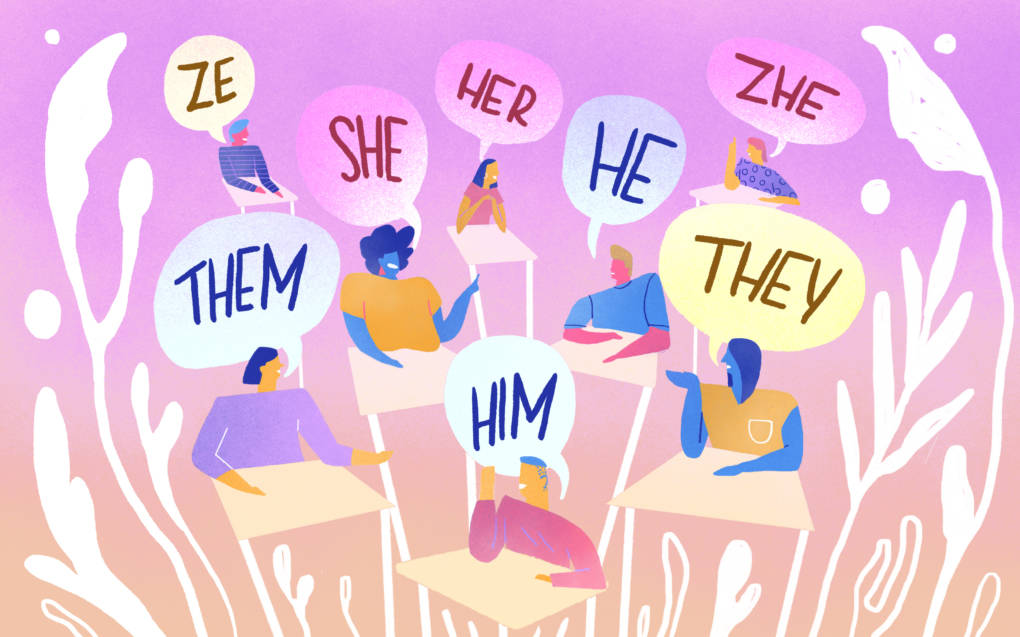
On the school administration level, both teachers told me that their school have asked students to choose how they want to be addressed, and when in Chinese classes, the pronouns (他/她/TA/names) used to address the student will be cohesive to their English choices (he/she/they/names). One teacher has also mentioned that when designing prompts and activities for the class, their supervisor has suggested to them not to enhance gender stereotypes, such as giving a role introduction like “the mom of the family is always busy with housework”.
Both teachers used Integrated Chinese as their textbook, and both have noticed that the materials and images presented in the textbook are stereotypical. There are always heterosexual families, boyfriends and girlfriends together, and more white people than other minorities. Both teachers mentioned that they will try to balance the race presented in their supplementary materials, especially pictures when preparing for the class. They will also try to include pictures that break gender stereotype, such as women bus drivers and male nurses. They will also pay attention not to assign roles to students based on their gender when doing role plays. When asking students questions about their families or relationships, they will pay attention to avoid biases in their wording. They will ask students “If your girlfriend or boyfriend …” no matter the gender of the students, instead of making heterosexual assumptions. One of the teachers said she will show students non-traditional families or queer groups when talking about topics such as families or relationships but have never discussed the topics in depth. The other teacher have not initiatively brought up non-traditional families or queer people unless she know that the students are related to the queer groups. For example, she added that “it is also normal to have two dads or two mums in the family” when she knows that one of the students in her class have a homosexual family as their neighbor. The teacher also mentioned that when teaching Chinese characters with the female radical, she will emphasize that “traditionally, Chinese think that mothers should be female”.
Neither of them have experienced times when their students ask about or reveal themselves or their acquaintances as queer, and neither of them has led in-depth discussions about queer issues. They gave three major reasons why they did not include discussions about LGBTQ+ in their classes: first, the class time is limited for grammar and vocabulary, and thus there is little time for discussions about these topics; second, for lower-level students, it may be hard to talk about these topics; third, students have access to knowledge and reflections about LGBTQ+ in other classes or club activities, so they do not think it is of vital importance to talk about that in language classes.
From the interview, I found that in the Chinese classes in these two private high schools, LGBTQ+ inclusion pedagogy is seen as something good, but not important. I am glad that both teachers interviewed have the awareness to avoid stereotyping in language classes, but they are mostly doing that implicitly and have never brought that topic up to the front for the class to discuss. The reasons the teachers gave for not including queer contents into language classes sound very familiar to me. In literature about language pedagogy composed in the 1990s, language teachers gave similar reasons for not including culture in language classes. Today most language teachers have seen culture as an inevitable part of language teaching, but LGBTQ+ inclusion still has a long way to go.
I am also glad that the teachers have noticed the bias in the contents presented by the textbooks and have made their endeavors to include diversity in their supplementary materials. They have even noticed the stereotypes in the language itself and pointed that out to the students. However, gender is not seen as important as race in terms of inclusion. Besides, as they both mentioned the LGBTQ+ club activities and affairs held by student organizations in their school, they do not think they bear an important responsibility of including LGBTQ in language classes.
Beyond the reasons and reflections discussed above, I am also worried about the difficulty of discussing LGBTQ issues in Chinese. As those groups are still under oppression in most Chinese-speaking communities and that most native speakers have not learned how to talk about and interact with the queer group, it may be hard for teachers to develop lessons from authentic materials in this topic and bring that up for class discussion.


Hi Keyue,
Thank you for sharing. I am glad you looked into this issue from the Chinese teachers’ perspective. Several thoughts through my reading of your post:
1. Yes, teachers are familiar with “inclusive pedagogy”, but not specifical “LGBTQ+ inclusive pedagogy”. We may pay more attention to race inclusion, esp. 2020. As individuals, we are led by massive media and the top topics of society.
2. I am glad to see that teachers seek supplementary materials for the students. I found I didn’t pay attention to this in the past.
3. You mentioned that a teacher would bring up queer issues if s/he has a queer student. I am not sure if I agree with this. I believe bring up LGBTQ+ issues to everyone could reduce discrimination.
4. Your last point on “how to talk about LGBTQ+” in Chinese made me think that we still have discrimination words in Chinese, like 基佬,gay里gay气. I think the change of language itself should function like a tool to change discrimination.
Hi Xinxin, thank you for your reply. On the discrimination words in Chinese, I think the discriminative implications of the queer words, such as “基佬“ or “gay 里gay气” is undermining in some discourses. For example, nowadays, “基友“ is not used to imply your homosexual partners anymore, but a “popular and fancy” way of addressing “good friends” or “homies” of any gender. Meeting net friends offline is also called “面基”, which is short for “当面搞基“, and literally means “developing a gay relationship face-to-face”.
I have complicated feelings about these changes in the implications of gay-related words. On one hand, it undermines the discriminative implications, while on the other hand, it neglects and diminishes the suffering of the LGBTQ+ people in public discourses, thus making it even harder for them to have their voice heard and their rights claimed.
I wish I could speak Chinese! I would like to understand what these words meant!
I agree with your thoughts – both Keyue and Xinxin – that some people foreground race related issues and see race as the problem…That’s why intersectionality is really important – to be able to see different forms of oppression in interaction with each other rather than individual events/forms of oppression. Here’s an interesting video on this:
https://twitter.com/i/status/1306653747855134720
I would however put capitalism as the head of the octopus rather than patriarchy I think…
Online games often have regular updates and new content, keeping players engaged and providing a constantly evolving entertainment experience.
植村秀專櫃必收神器:化妝棉、腮紅刷與遮瑕全攻略
shuuemura哪裡買最便宜
植村秀
shu uemura
值春秀
植春秀
植村秀專櫃
植春秀日本
植春秀台灣
植村秀日本官網
植村秀 jp
植村秀哪裡買便宜
植村秀防曬哪裡買最便宜
植村秀 遮瑕
植村秀 粉餅
植村秀妝前乳
植村秀粉底
植村秀遮瑕
植村秀定妝
植村秀隔離霜
shuuemura哪裡買最便宜
植村秀眉筆
植村秀口紅
植村秀唇膏
彩妝
shuuemura哪裡買最便宜
植村秀 卸妝
植村秀洗面乳
植村秀潔顏油
植村秀 卸妝油
植村秀專櫃
shuuemura哪裡買最便宜
養肌彈嫩霜
無極限養肌精華油
shuuemura
植村秀
雙色蕊盒
睫毛夾
植村秀化妝棉
專業腮紅刷
Really well-researched and written.
I’ll definitely be coming back for more.
Every sentence here adds value.