
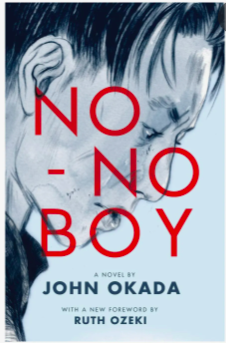
Reflection 2: Short Book (No-No Boy)
The book that I selected for this reflection is No-No Boy by John Okada. This book focuses on the main character Ichiro Yamada, a first-generation Japanese American, who decided not to serve on America’s side during World War 2. Those who decided not to serve on America’s armed force was sent to prison for two years as a punishment for not being loyal to America. The author highlights that many Japanese Americans decided not to serve in the U.S. armed force because they were pressured by their family members to not support a war that was going against their home country, Japan. Other Japanese Americans decided that they could not support the U.S. because they were forced into Japanese internment camps as a punishment and fear of the Japanese government bombing Pearl Harbor. Rejecting serving in the U.S. army not only earned Japanese Americans two years in prison, but it also earned them the name no-no boy.
After his two-year prison sentence, Ichiro returns home to Washington where he has to renavigate his life outside of prison and his life outside of the internment camp. While he is home, Ichiro faces discrimination for not serving in the war and receives judgement from his younger brother, Taro, who is adamant about joining the U.S. army once he turns of age. Although Okada hints that Ichiro feels some regret for not serving the U.S., Ichiro’s mother praises him for being a “good” Japanese man and son for not betraying his mother’s country. Throughout the book, it is suggested that Ichiro wants to find a balance between his Japanese and American identity but fails to do so in the end.
I would consider using this book for language teaching purposes as Okada draws on experiences that many Japanese Americans encountered post-war. In the book, Ichiro has a lot of self-dialogues which I think would be a good opportunity for students to analyze and reflect upon. In addition, I can have students compare and contrast Ichiro’s experiences to other Japanese Americans during this time period. I envision myself using TED Talk videos or documentaries that highlight Japanese American experience in the U.S. while World War 2 was happening. If I was using this book and teaching in L.A. I would also try to plan a field trip to the Japanese American National Museum located in Downtown L.A. In this way, students can ask historians questions about the Japanese internment camps and can see an exhibit on these internment camps. Because of the complex vocabulary and the structure of certain sections, I feel that this book can be used in an intermediate-high to advanced- mid level language class.
Some discussion points that students can reflect on as they read this book include:
- In the book, how does Okada distinguish between a Japanese person, an American person, and a Japanese American person?
- Why does not Ichiro’s mother accept that the Japanese lost the war?
- How is proving one is “American” represented in this book? Do you agree with this representation? Why or why not?
- In what way does Ichiro experience racism in a post-war American society?
In many ways, this book embodies/ reflect the core concepts and issues we discussed in the class. This book references that many people of color treated Japanese people poorly in order to show their devotion to America. For example, there were non-Japanese people in the book who treated no-no boys as objects and would question their “Americanness” for not serving the U.S. Even though many people of color experienced hardships under the U.S. government, they did not want to be associated with any Japanese people and be considered a Japanese “sympathizer.”
Additionally, reading No-No Boy reminded me of the “A Pedagogy of Pain” reading we had. In order to grow as individuals, we must address the pain and hardships that we experience. Many characters, especially Ichiro’s parents did not want to talk about the war, Ichiro’s prison sentence, and even the internment camps. Ichiro is expected to “get over” everything that has happened. However, he just wanted someone he can talk to about his struggles and learn how to transition back into society. In addition, class was represented in the book. Once released from the internment camps, many Japanese people had to start from scratch. They could not go back to their homes because they lost ownership of it and there were no records to contest it. For those who had higher-paying jobs, they could not go back to them because the position was not available or there were not many employers willing to higher Japanese people. This in turn led many Japanese people to look for work outside of their desired profession.


Hi Sharon, it was really informative and thought-provoking for me to read your reflection of No-No Boy by John Okada. I think it is so important that this novel highlights the perspective of being a Japanese-American during World War II. Hearing about the discrimination that Japanese-Americans faced in society (on top of the cruelty many faced in the internment camps) actually reminds me of a story my grandmother told me. My grandmother is Finnish, and up until elementary school (which she attended in the United States) the only language she spoke was Finnish. She told me that when she began elementary school in 1944, the other kids called her Japanese because she didn’t speak English, and would berate her and refuse to talk or play with her because of it. While what my grandmother experienced was nowhere near what Japanese-Americans had to experience during that time, I feel like her story just goes to show the societal discrimination against Japanese-Americans (that they were also passing onto their young children). Thanks again for sharing this thoughtful reflection, Sharon!
Thank you for your comment and sharing your grandmother’s experience, Stephanie! I totally agree with you in that societal discrimination gets passed down onto the younger generation. It reminds me how a lot of stereotypes and discrimination against a group of people (race and ethnicity, socio-class, etc.) starts in the home.
Hi, Sharon , it seems like a really good book and I should also read it. I also read about the questions that you listed, and they are about identity, immigrants and racism. I also find it a interesting to look at Asian Americans and how they identify themselves. There are so many elements: culture, nationality, race. And people seldom talk about it (I think it is the same with ABCs and ABKs). Also, it fits with the “Asian hate” situation to raise people’s awareness. Thank you for sharing your thoughts and they are so inspiring.
Hi June! Thanks for your comment. I also find it interesting how Asian Americans identify themselves. Based on my own experience, I feel that I don’t necessarily fit into American society because I still celebrate some traditional Chinese holidays, speak my dialect within my home, and hold a lot of Asian values (collectivism, filial piety, etc). However, I feel that I don’t fit into Chinese society because I wasn’t born in China, don’t speak the language well, and don’t have a solid understanding of the culture abroad.
While reading the book, it also reminded me of “Asian hate” that has been going on. It specifically reminded me of how a lot of Asian people were saying “I’m not Chinese” and why are you attacking me? To me, it shows the distance that some Asian people wanted to have towards being viewed as Chinese.
Hi Sharon! Thank you so much for sharing this thoughtful reflection. I have added No-No Boy to my reading list! American internment of Japanese Americans is a part of history that was not discussed in any of my classes throughout high school; I did not even know about it until a teacher mentioned it somewhat offhandedly in 9th or 10th grade, but it was never an area of formal study in English or history classes which I think speaks volumes to the priorities of the American education system. Your reflection and discussion points highlight what it means to be an American and how society can demand that some, but not all, folks have to prove their ‘American-ness.’ I imagine this is an experience that many people in the U.S. can relate to, even beyond the Japanese American or Asian American contexts. I have several Arab American friends who have expressed feeling too Arab for Americans, but too American for the Arab communities they are a part of. Particularly in the Arab diaspora in America, a lot of this actually is a result of anti-Asian legislation. For many generations Arab immigrants attempted to assimilate to White America as a way of distancing themselves from anti-Ottoman, Chinese, and Japanese legislation at different points in history. All this to say, you bring up such a great point about proving American-ness, and your reflection really drives home the point for me that all struggles rooted in social identities are interrelated. I also want to highlight that you honed in on Ichiro’s self-dialogue as a potential opportunity for student analysis. I really like this tangible example. Thanks again, Sharon, for this great reflection!
Hi Sydney, thank you for your comment. When I was in high school, I also wasn’t aware of the American internment of Japanese Americans. When I took AP US History, one of my history teachers briefly mentioned it in one of my classes and never talked about it again. In my most recent experience teaching high school students, the Japanese American internment camps are never talked about. This historical event is in students’ textbooks, but they’re just not taught.
Thanks for sharing a bit about the Arab American experience as I’m not too familiar with it. I feel that a lot of the experiences of Asian Americans, Arab Americans, etc. are at one point very similar.
Sharon, thank you so much for your reflection and for the synopsis of this history! I think your idea of taking students to the museum (or them going there on their own if a group outing isn’t possible) is a fantastic way to crystalize the history for them. I have visited the Heart Mountain Relocation Center near Powell, WY many times, and it is extremely powerful to be in locations where such gross injustices were perpetrated in the name of the American people.
I also highly recommend George Takei’s “They Called Us Enemy” as an additional or alternative text on the subject of Japanese internment (especially since it is based on Takei’s firsthand experience of internment).
This history also allows you the opportunity to talk about the topic of reparations, the Civil Liberties Act of 1988 (in which Japanese Americans who had been interned in camps were paid $20,000 for the wrongs done to them), and to talk about which communities are yet to receive reparations for the wrongs done to them by the federal government (e.g., Native folks who were forced off of their lands, Black folks whose ancestors provided generations of free labor before the abolition of slavery, Native and Puerto Rican women who were involuntarily sterilized up until the 1970’s as a form of population control, the illegal overthrow of the Hawaiian monarchy and the dispossession of Kānaka Maoli/Native Hawaiians, etc).
Another subject that you can bring up is how it wasn’t just Japanese and Japanese Americans who were interned with the signing of Executive Order 9066, but also Aleut people (the indigenous people of the Aleutian Islands) who were interned in SE Alaska where some 10% of them tragically and senselessly died (see: “When The Wind Was A River” by D. Kohlhoff, 1995).
Hi Greg, thanks for adding your thoughts to the ones that I suggested in my original post. I really like the idea of addressing reparations in terms of the injustices that people have experienced. I think it would also be a great idea to address how giving people who went through injustices or families of people who experienced injustices “X” amount of money, doesn’t erase the harm done.
I wasn’t aware that Aleut people were interned in Alaska with the signing of Executive Order 9066. I’ll have to do some additional research on it.
Hi Sharon, thank you for your reflection on this book about a part of American history that many Americans would prefer to ignore or aren’t even aware of at all. I remember that when I was a kid, I was talking with my friends who have Japanese heritage about our favorite presidents. I said FDR because my dad often praised FDR’s New Deal policies at home. However, my friends’ mother (who was not of Japanese heritage; her husband was) said, “but he put Japanese Americans in internment camps.” I acknowledged that she was right and we moved on. I think I was too young to fully understand the seriousness of what I had said. When we are in elementary and middle school, we learn about presidents and US history in general at such a shallow level, usually focusing on presidents’ and US accomplishments. I think the erasure/trivialization of historical discrimination faced by Asian Americans has a direct connection to the normalization of discrimination against Asian Americans today. As Greg mentioned, studying the content of this book can also lead to studying other little-known or erased history against marginalized groups and how it connects to discrimination and inequality in the US today.
Hi Zoya, thanks for your comment. I agree with your points raised, specifically about the erasure/ trivialization of discrimination against Asian Americans. In the beginning of the pandemic, I was still working at a high school and received a lot of discriminatory comments from my students regarding my identity and the pandemic.
I asked a teacher, who I worked with and who taught Ethnic Studies, why Asian American history isn’t taught in the course. He told me that there wasn’t room to talk about it because the administrators didn’t feel that it was needed. I was baffled by the comment because the Japanese internment camps is part of not only California’s history but it is also part of U.S. history. In general, it also relates to the Ethnic Studies course. I often wonder if administrators added a unit on the “Asian American” experience in the U.S., if it would have made a difference in how my students viewed the pandemic.
What an interesting, insightful book Sharon. I also enjoyed reading the perspectives and suggestions your friends brought to the discussion here. There are so many ways to read/examine this text in language classes for sure. I guess what stood out me the most – and you and your friends also brought it up above – is the identity aspect of it, the way it yields to discussions around who is American? who is US vs them? and how it relates to what DuBois talks about as “double consciousness.” There are so many layers to this text/topic and like Sydney, I will add it to my list to read!
Hi Deniz, thanks for your comment. There were so many angles this book can be viewed from. If I do get to use this book in my language class, I would be really excited to hear the different ideas from my students.
Mengungkap Rahasia Angka Keramat
Meskipun banyak yang percaya pada kekuatan Angka Keramat, skeptisisme juga ada. Beberapa ahli mengatakan bahwa keberhasilan atau kegagalan seseorang tidak sepenuhnya ditentukan oleh angka, tetapi lebih banyak oleh tindakan dan keputusan yang diambil