
How America’s Public Schools Keep Kids in Poverty (DMR)
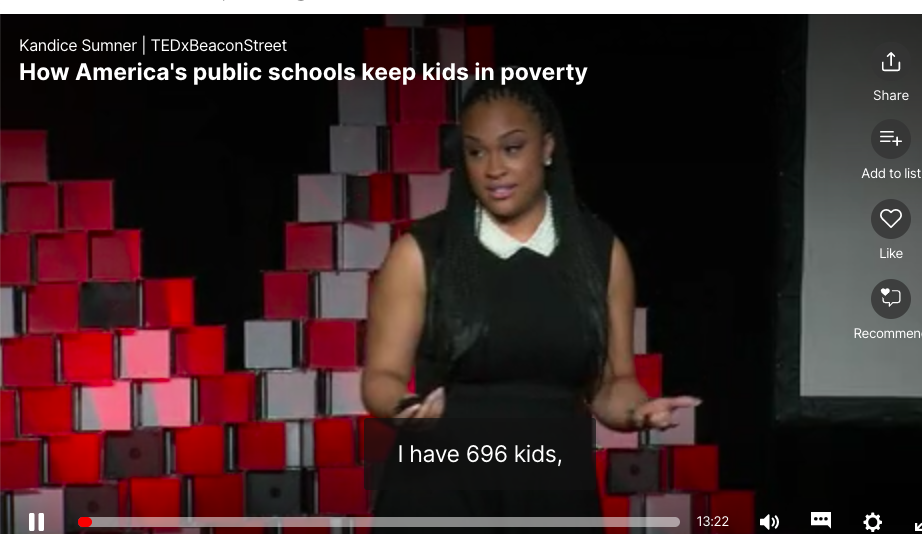
I watched this TED talk in my last year with City Year. The speaker, Kandice, shares her experience working in a public school in Boston and shares how there is lack of resources present in public schools. She also emphasizes both the historical, institutional, and social injustices that people of color face in these public institutions.
One quote that stood out to me was, “The quality of your education is directly proportionate to your access to college, your access to jobs, your access to the future.” Although this quote does have truth, I think that it’s important to acknowledge that teachers also play a big role in shaping students’ academic and non-academic trajectory and goals.


Hi Sharon, thanks for sharing this resource! I have actually watched this Ted Talk before, but I just watched it again because I just love all the points she brings up in her talk.
While listening to her Ted talk it made me think of Jonathan Kozol https://www.jonathankozol.com/ I have read a few of his books. He is a writer, educator, (also taught in the Boston Public School system like Kandice) and activist for reforming the American Public School system.
I also like she brought up the student achievement gap, which is something that Ibram X. Kendi talks in his book How To Be An Antiracist. A direct quote from his book, “The idea of an achievement gap between the races–with Whites and Asians at the top and Blacks and Latinx at the bottom–creates a racial hierarchy, with its implication that the racial gap in test scores means something is wrong with the Black and Latinx test takers and not the tests.” This comes from his chapter on behavior.
I also like that she brought up the Macro, Meso, and Micro levels of society. Not everyone can do everything but everyone can do something. In both of my ICC classes we discussed and broke down these levels. We also touched on the mecro level (your inner/individual beliefs) which she did not speak about.
I like that you brought up the point of not only having equal access to opportunities and resources, but also acknowledging that teachers play a huge role in a student’s life. Something that we both touched on in our privilege reflections.
Sharon, thank you so much for sharing this TED Talk. It’s not one that I had seen before, and I am glad to have had the opportunity to watch it now because it was very powerful. It was difficult to hear the speaker talk about being so young and feeling guilty for the experiences she was having because many of her friends weren’t able to have those same experiences (it stuck with me when she said “all of my neighborhood friends were experiencing an educational train wreck that I was saved from through a bus ride”). It also stuck with me later in the talk, when she was describing the reactions of kids in her class who were confused as to why they were getting new books, and then being so excited to read once books were available to them. Additionally, Sharon, I like your point about the important role that teachers play in shaping students’ goals and trajectories. Public schools across the country have many wonderful teachers who absolutely have an impact on students, and it is important that schools are also equipping these teachers and students with tools and resources that will help them excel. Thanks again for sharing this talk, Sharon!
Hi Yanci and Stephanie, thank you both for sharing you thoughts! I know you mentioned Ibram X. Kendi’s book in several of our classes, Yanci and have definitely added this book to my list of books that I want to read. You both brought up great points of how different factors in our lives (internal or external) has an influence over students quality of education.