
Gaysian isn’t a “thing” everywhere
During my interview with my student for this reflection, I had to keep thanking every diety out there that I was born and raised in a hyper-liberal area of the world where being part of the LGBTQIA+ community does not mark you as a social pariah.
My student is a hetero-cis-male from one of the richest neighborhoods in the capital city of South Korea. He embodies the imagery of dominant culture. He is also one of the most open-minded, well-spoken, critical thinking person I have ever had the pleasure of talking to.
I started by asking him how he felt about hte LGBTQIA+ community in Korea. He stared at me blankly. I explained to him what each of the letters stood for, and he was even more confused. He asked me what the difference was and why (Q)ueer people felt the need to identify themselves as such, marking themselves as different from society. We started talking about the reclaimation of social power through removing the negative connotations of words and using them to empower oneself. This led to various topics which I will outline here.
The first was about cultural dimensions. Korea is a very collectivistic country. What an individual does should be for the improvement of the entire community, not for selfish motivations. He told me that people are not quite open to the idea of “alternative” sexualorientations / gender orientations. More and more representation is happening in movies and dramas, but this is a very recent development. The characters are usually very stereotyped though. He believes that people are not comfortable with the idea of LGBTQIA+ identities. These identities are so peripheral that the dominant society does not even suspect others of being a part of it because “it’s just not done in Korea.” Gay marriage is not allowed in Korea, nor does the Korean government accept gay unions performed outside of Korea. He explains further that babies are assigned with a sex at birth and the only people considered “families” are ones that include one man and one woman.
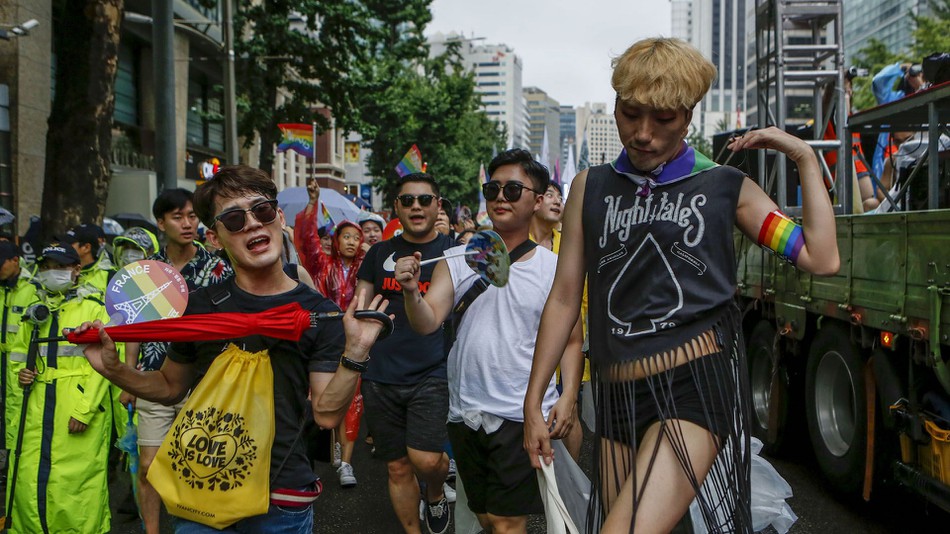
We then watched this video on YouTube about Korea’s Queer Pride Parade.
I asked my student if the push back against queerness stems from the church. My student said that that was quite possible. He tried to do some quick research on attitudes towards queer people prior to Catholicism but said it would take too much time to translate during our class period.
He does not feel as though queer students stand out any more than any other type of alternative identity. Korea is very homogenous (on the surface), and most people want to keep this harmony. He said that they want to push the country forward more than they want to push personal agendas forward. He did not understand why one would need to be an ally to these students because they are not any different from anyother students struggling from any sort of identity confusion.
I think there is a major disconnect here. Where he does not see a problem, there clearly is, otherwise there wouldn’t be a Queer Pride Parade, nor hundreds of thousands of protestors against the cause. I think in collectivist cultures such as Korea, being an ally is even more important. As seen in the video, so many people think that sexual orientation is a choice. LGBTQIA+ people are “choosing” to be different. For what? Why would they purposely ostracize themselves from their family and community? People believe that these communities can just be convinced to return to being “normal.”
I do not think the country is particularly unsafe for LGBTQIA+ students physically, but mentally, it is definitely a detriment. Allies would probably also be shunned by greater society, or seen as deviants. I was asking him how he thought the situation could change in the future, and he said it won’t. The only way to escape the overbearing societal pressures of Korea is to leave.


Ann-your reflection reminds me once again that even our educated ones are very ignorant when it comes to sexual identities. Personal choice, biological disorder, or even mental disorder…These are how LGBTQ+ members are perceived as. One of my friends had said that she sees it as a tendency, that the more young people see LGBTQ+ people on TV or in the media, the more tendency they have to “imitate” them.
Thanks for sharing the video – This is what Gay Parade looks like in Turkey: https://www.youtube.com/watch?v=c25u_VlchGg [police violence!]
I do think it has something to do with the fact that South Korea is very group-oriented as opposed to America’s individualistic mentality. South Korea also very recently rapidly industrialized. Maybe because of their lack of exposure (compared to more Western cultures) that it’s easier to continue to bury their heads in the sand when it comes to “alternative” sexualities. It’s not like all of America is very accepting either. I think we are particularly lucky to be in a more progressive area of a very progressive state.
My student did think that somehow more exposure to westerners is making more Koreans “feel gay.” I’m not particularly surprised because in Japan, foreigners were blamed for STDs and STIs even though they don’t teach sexual health in Japanese schools. Hopefully we’re all just slowly moving towards accepting people for who they are.
Regarding the idea of collectivism as relating to ostracizing LGBTQ identities, I had similar thoughts when discussing gay marriage with someone in Morocco last year. He was a member of the Berber ethnic minority in Morocco, so he had an interest in social justice, but he expressed to me that he and (he felt) other Moroccans just don’t understand why people would want to get into same-sex relationships. I think this springs from the idea of the heterosexual family, and the production of children, as providing a major service for the community. In this view, if you can’t produce children, what is your relationship doing for the society? I feel like the idea of marriage as providing a service to the society (which exists in other cultures too—it’s a tenet of the Hindu religion, for example) is very different from the American concept of getting into a relationship for the enjoyment of you and your partner only.
Dibawah ini kami sudah menyediakan tabel Rekap Paito Sgp dan Paito Sdy yang mana didalamnya sudah kami masukan semua Hasil Pengeluaran dari awal tahun sampai dengan sekarang ini lengkap ada
didalamnya.
website:
Paito Sgp
Paito Sdy
looking for were to oder your psychedelic products i recommend you get them from https://psychedelics-home.com