
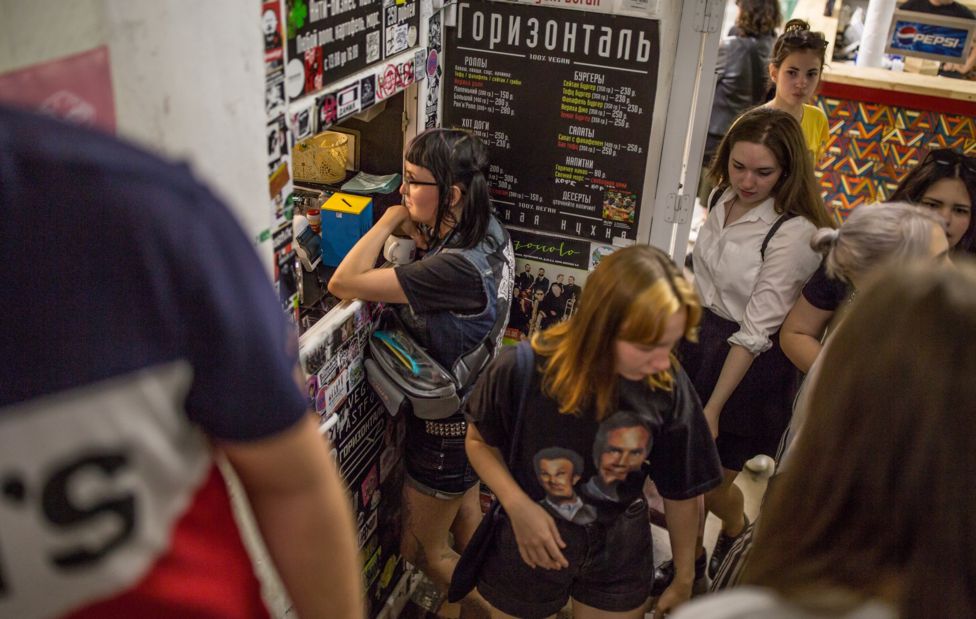
Horizontals Who Fight for Equality
In this article, a group of activists in St. Petersburg, Russia have been challenging societal norms by fighting for LGBTQ+ rights among many other social issues in Russia. The group calls themselves “Horizontal” because they do not recognize hierarchies in their community. Everyone is treated with respect and equality no matter their race, gender, sexuality, or socioeconomic status. Horizontal has opened several vegan restaurants across the city where they hold lectures and workshops on a variety of topics. They claim to represent “vegananarchy” where food is a form of activism used to challenge Russian societal norms. Their goal is to create change within by becoming their ideal society and in turn, positively affecting Russian society.
In Russia, there is a law banning the positive depiction of same-sex sex relationships in any media that can be consumed by children, including the internet. The group has actively worked to challenge this law, but not surprisingly, they have received much push-back. Though they have been targeted by the general population, they hope that by radically opposing the law and bringing different perspectives into the conversation, they can at least begin to enact change in the local community.
Though the article is long, I think it could be adapted/shortened and used in an English Language course. I wonder how students from Russia would react upon reading the article. I wonder if Horizontal is widely known in Russia and what outsiders think of them. I think this article is powerful because it challenges those that are deterred from enacting change when the law prohibits it. The article shows how small changes in a community can have a ripple effect on the society as a whole.


Kalina, thank you for sharing this interesting article! Wow, I’d actually never heard of “veganarchism” before I read your post. I understand that being vegans protects animal rights, leading to a sort of activism, but I found it so interesting that the word can be expanded to tackle other problems like racisim and LGBTQ issues. I think it shows intersectionality in some ways.
Regarding your question about how Russian students would react to this article, I once had a discussion about LGBTQ with the current MIIS graduate students in the professional presentation class, and the two Russian guys brought up the news of gender-neutral barbie dolls going into the US market and told us how it would be completely discouraged in Russia. They said that the country is quite conservative in these issues and won’t accept spreading the notion of gender diversity among children. I think this is related to the law you are discussing here. I’m also curious to see how widely known Horizontal is in Russia, so I’ll try asking the Russian students next time I meet them and let you know!